
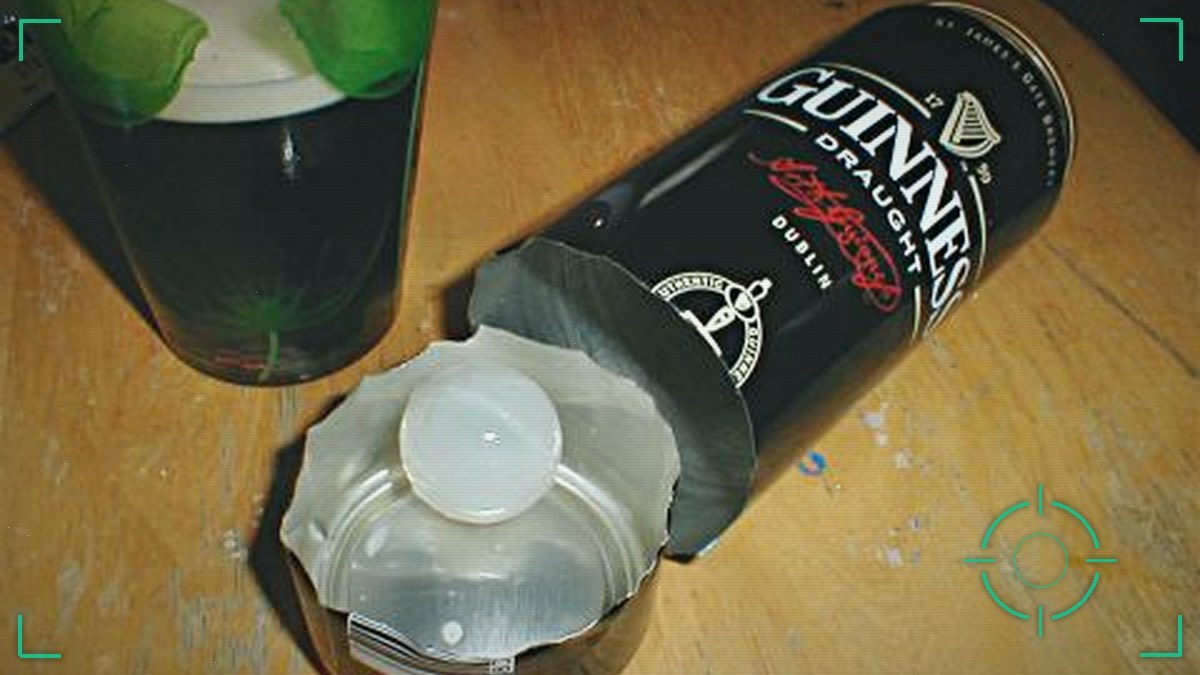
The style gets its creamy head and soft, low-fizz pour from nitrogen dissolved alongside the usual carbon dioxide. In a can, a small device called a widget does the job a tap does at the bar. Guinness calls its widget a nitrogen-filled ball that “releases the magic surge of bubbles” the moment the can opens.
Reference Log
Why nitrogen makes a nitro stout creamy
Nitrogen is about 50 times less soluble in beer than CO2, according to a review of beer bubble physics in Beverages (MDPI). Including dissolved nitrogen does two things: it makes the bubbles smaller and it reduces acidity.
Stout bubbles are typically about a tenth of a millimetre across, while bubbles in ordinary carbonated beers are millimetres across, according to a paper in the American Journal of Physics. Those small bubbles give the head its creamy mouthfeel. Because nitrogen is less acidic in solution than CO2, these stouts also taste smoother and less acidic.
Why a nitro stout is lower in carbonation
Nitro beers hold less dissolved gas overall, and the gas they do hold makes bubbles slowly. Bubble growth is slow because nitrogen dissolves so poorly, and that is why a nitro pint takes a while to settle. It is also why the head lasts longer than on a regular beer.
How a widget works
Some canned beers are pressurized by adding liquid nitrogen before sealing, Wikipedia explains. The nitrogen turns to gas, pressurizes the can and forces gas and a little beer into the widget’s hollow interior through a tiny hole. When you crack the can, the pressure drops and the widget jets gas out. That jet stirs up the beer and sets off a chain reaction of tiny bubbles.
Guinness’s widget work dates to a system developed in 1984 by Alan Forage and William Byrne, with a British patent application published in 1987, according to New Scientist. The first-generation widget, a plastic disc fixed in the bottom of the can, launched nationally in 1989. The floating widget, which Guinness calls the “Smoothifier,” followed in 1997.
Nitro stout on tap vs. in cans
| On tap | In a can | |
|---|---|---|
| What makes the foam | Restrictor plate in the faucet; the pour itself mixes the beer | A widget jets gas when the can is opened |
| Why it’s needed | Low-solubility nitrogen needs agitation to form bubbles | Opening a can doesn’t mix the beer enough on its own |
| How to pour | Let the bartender pour and let it settle | Pour right away; nitrogen escapes fast |
Sources: American Journal of Physics; Beverages (MDPI); New Scientist.
Both stout formats need special hardware, a restrictor plate on draft and a widget in cans, according to the American Journal of Physics paper. New Scientist adds that a widget can should be poured immediately so the nitrogen doesn’t escape.
Nitro stout FAQ
Pour one and watch the cascade
Now you know what’s happening in the glass. For a Welsh twist, see how Brains Black became Cardinal Black, then read our November barrel-aged stout releases.
Transmission complete.
BEERALIEN.COM | Reporting on Earth’s finest craft beers from a galaxy far, far away.


 BeerAlien

 Raymond

 Terry Bunch


