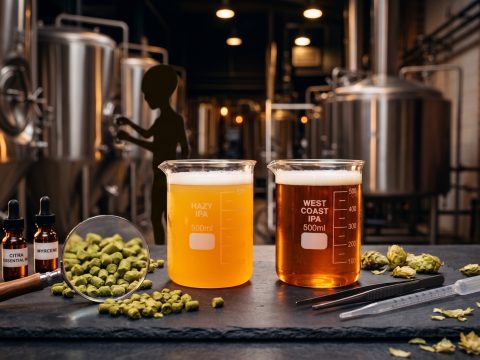
In modern craft brewing—particularly within the relentless evolution of India Pale Ales—the quest for maximum hop saturation with minimal vegetative interference has shifted from a subtle preference to a primary technical discipline. Historically, brewers relied on whole cone hops and traditional T-90 pellets to deliver alpha acids, beta acids, and delicate essential oils to the kettle and fermenter. However, as hop dosing rates for Double Dry-Hopped (DDH) IPAs scaled from 2 lbs/bbl to upwards of 5 or 6 lbs/bbl, traditional hop formats exposed critical mechanical, sensory, and economic limitations.
When evaluating hop extracts vs whole cone hops and standard pellets, modern advanced hop products—including Cryo Hops, Incognito, Spectrum, Salvo, and isolated terpene distillates—re-engineer the entire brewing process. Under the microscope, analyzing hop extracts vs whole cone formats reveals how concentrated lupulin glands deliver maximum aroma and bitterness while drastically altering hot-side efficiency and cold-side process yields.
Reference Log
1. Lupulin Concentration & Cryogenic Separation
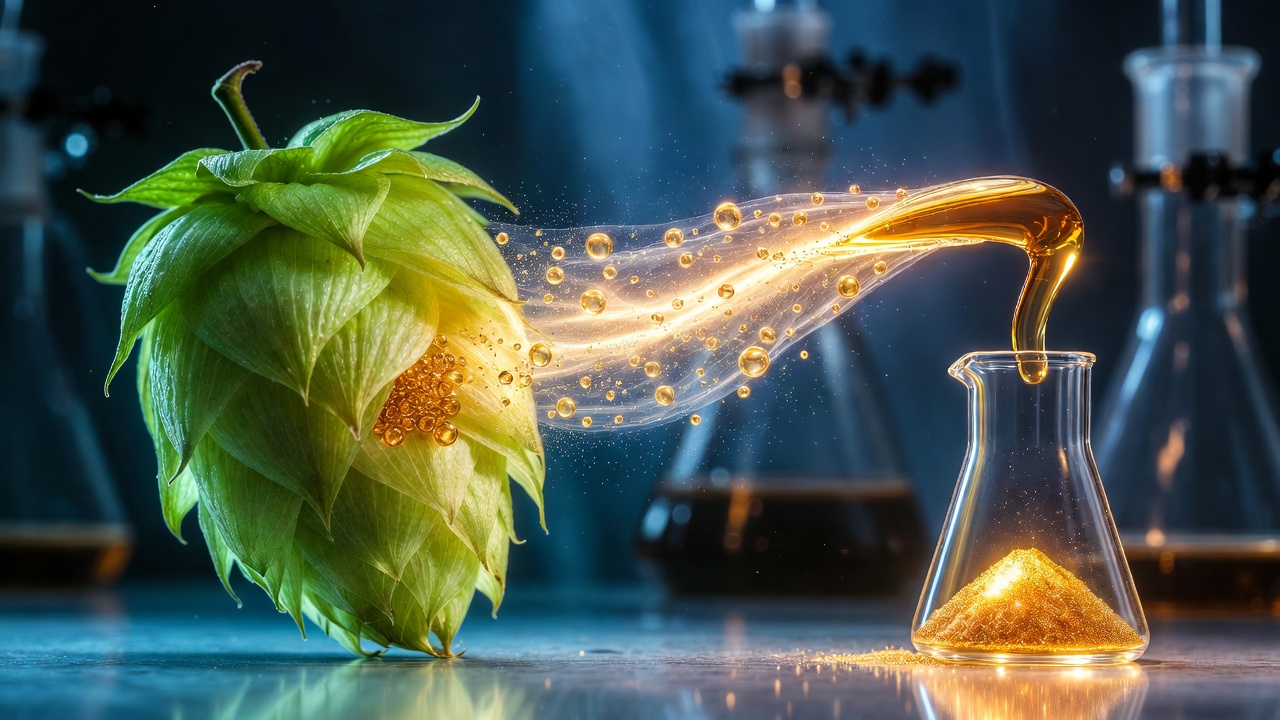
To evaluate the true science behind hop extracts vs whole cone hops, we must first look at the anatomical structure of the hop cone (Humulus lupulus). The outer structure of the cone consists of the central strig and surrounding vegetative leaf material known as the bract and bracteoles. Nestled at the base of these leaves are the lupulin glands—tiny, golden resin sacs containing alpha acids, beta acids, and volatile essential oils (myrcene, humulene, caryophyllene, linalool, and geraniol).
-
Traditional Hop Pellets vs. Cryogenic Processing
In traditional T-90 pellet production, whole hop cones are hammermilled and compressed through a die. Approximately 90% of the raw plant material is retained, meaning that for every pound of hop aroma and bitterness added to a vessel, a substantial volume of green vegetative matter enters as well.
Cryogenic separation revolutionizes this process by freezing whole hop cones in a nitrogen-rich, oxygen-free environment at extremely low temperatures. Under deep freeze conditions, the resinous lupulin glands freeze solid and brittle. Mechanical separation gently shears the lupulin glands away from the inert vegetative bracts.
Whole Hop Cone → (Cryogenic Nitrogen at -100°F+) → Isolated Lupulin Glands (Concentrate) + Vegetative Bract (Discard/Secondary)
Understanding hop extracts vs whole cone processing highlights why concentrated products double alpha acid and oil concentrations per unit mass compared to standard pellets. By removing half the vegetative weight, brewers eliminate the unwanted plant material that acts like a sponge in the fermenter.
2. Polyphenol Removal & Hot-Side Efficiency
Beyond physically soaking up finished beer during transfers, raw vegetative hop material introduces complex organic compounds directly into hot wort that fundamentally alter both sensory qualities and brewhouse efficiency: specifically, polyphenols. When comparing hop extracts vs whole cone additions in the kettle, managing these plant-derived tannins becomes a critical chemical balancing act for brewers striving for clean bitterness.
-
The Impact of Polyphenols on Beer Quality
Polyphenols are plant-derived polyphenolic tannins located primarily within the structural leaf material (the hop bract). When added in massive quantities during the boil or whirlpool, polyphenols interact with proteins in the wort to form insoluble complexes (hot and cold trub). However, elevated polyphenol extraction—driven by high temperature, extended contact time, and high vegetative mass—leads to key sensory and mechanical defects:
-
Harsh Astringency & “Hop Bite”: Polyphenols bind to salivary proteins in the mouth, causing them to precipitate out and leaving an astringent, dry, lingering metallic bite on the back of the palate rather than a clean, smooth bitterness.
-
Haze Instability & Muddy Appearance: While hazy IPAs demand a stable colloidal suspension, uncontrolled polyphenol-protein bonding creates heavy, oversized particulate matter that rapidly precipitates out in the package, turning desirable opalescence into unattractive, muddy sediment.
-
Trub Accumulation & Kettle Loss: Massive vegetative additions create dense, voluminous trub blankets at the bottom of the whirlpool. This thick cake traps large volumes of sweet wort, drastically reducing the net yield transferred through the heat exchanger and into the fermenter.
-
Flowable Liquid Extracts in the Whirlpool
To bypass the mechanical and sensory penalties of high-volume vegetative additions, modern brewhouses utilize advanced hot-side products like Incognito or Salvo. These flowable hop extracts deliver concentrated alpha acids and essential oils in a 100% natural liquid matrix, completely free of plant matter.
When comparing hop extracts vs whole cone performance in the whirlpool, replacing traditional additions with flowable extracts allows brewers to dissolve target alpha acids and volatile oils directly into hot wort without leaf material:
-
Trub volume is drastically reduced, minimizing kettle bottom sludge and maximizing wort recovery straight to the cellar.
-
Polyphenol leaching is virtually eliminated, producing a softer, rounder mouthfeel with a clean, non-astringent bitter finish even at extreme hopping rates.
3. Cold-Side Yield Economics in DDH IPAs
While hot-side efficiency gains are substantial, the true financial and operational breakthrough when analyzing hop extracts vs whole cone and pellets occurs in the fermenter during dry hopping.
-
The Dry-Hop Absorption Problem
tandard T-90 hop pellets act as absorbent sponges when introduced to cold beer. On average, standard hop pellets absorb roughly 0.5 to 0.7 gallons of beer per pound of hops added.
In a 30-barrel (bbl) batch of a modern Heavy DDH IPA dry-hopped at a rate of 4 lbs/bbl, the total dry hop load equals 120 lbs of pellets:
120 lbs of pellets × 0.6 gal/lb absorbed = 72 gallons lost (~2.32 bbl)
That equates to an immediate loss of ~7.7% of the total batch volume straight to hop sludge at the bottom of the tank.
-
Calculating Recovery Gains with Advanced Concentrates
Evaluating the financial impact of hop extracts vs whole cone pellets shows massive yield recovery when substituting standard T-90 pellets with cold-side soluble extracts like Spectrum or concentrated Cryo Hops:
-
50% Cryo Replacement: Replaces 60 lbs of T-90 with 30 lbs of Cryo, cutting volume loss in half (~36 gallons recovered).
-
100% Fully Soluble Liquid Extract Replacement (e.g., Spectrum): Leaves behind zero solid residue in the fermenter cone. Absorption losses from the dry-hop additions drop to zero.
Recovering 2 to 3 barrels of beer per 30 bbl turn translates to an additional 50 to 75 cases of packaged beer. At standard craft retail pricing, these yield economics easily offset the higher initial unit cost of advanced extracts, significantly lowering the overall cost per barrel of finished, packaged product.
FAQ: Advanced Hop Extracts vs. Whole Cone & Pellets
Conclusion: Mastering the Advanced Hop Spectrum
The modern brewing landscape does not mandate the total elimination of whole cone or pellet hops; traditional formats still provide essential aromatic nuance, depth, and biotransformation precursors. However, understanding the operational trade-offs of hop extracts vs whole cone hops allows modern craft brewers to blend precision liquid extracts with targeted pellet additions. The forensic outcome is clear: richer, fully saturated hop aroma, softer mouthfeel with reduced polyphenol bite, and dramatically higher brewhouse efficiency from kettle to cold block.

 Raymond