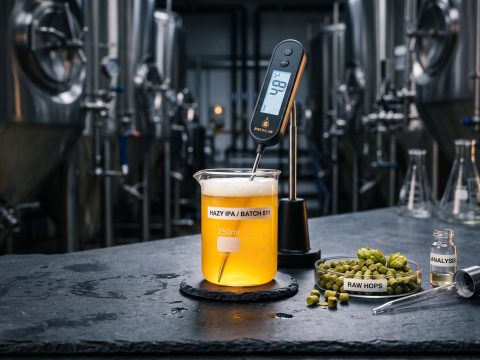
Welcome to our new series, Hop Forensics, where we break down the underlying chemistry, brewing mechanics, and sensory science behind your favorite craft beers.
Our first investigation: Does Hazy IPA go bad faster than clear IPA?
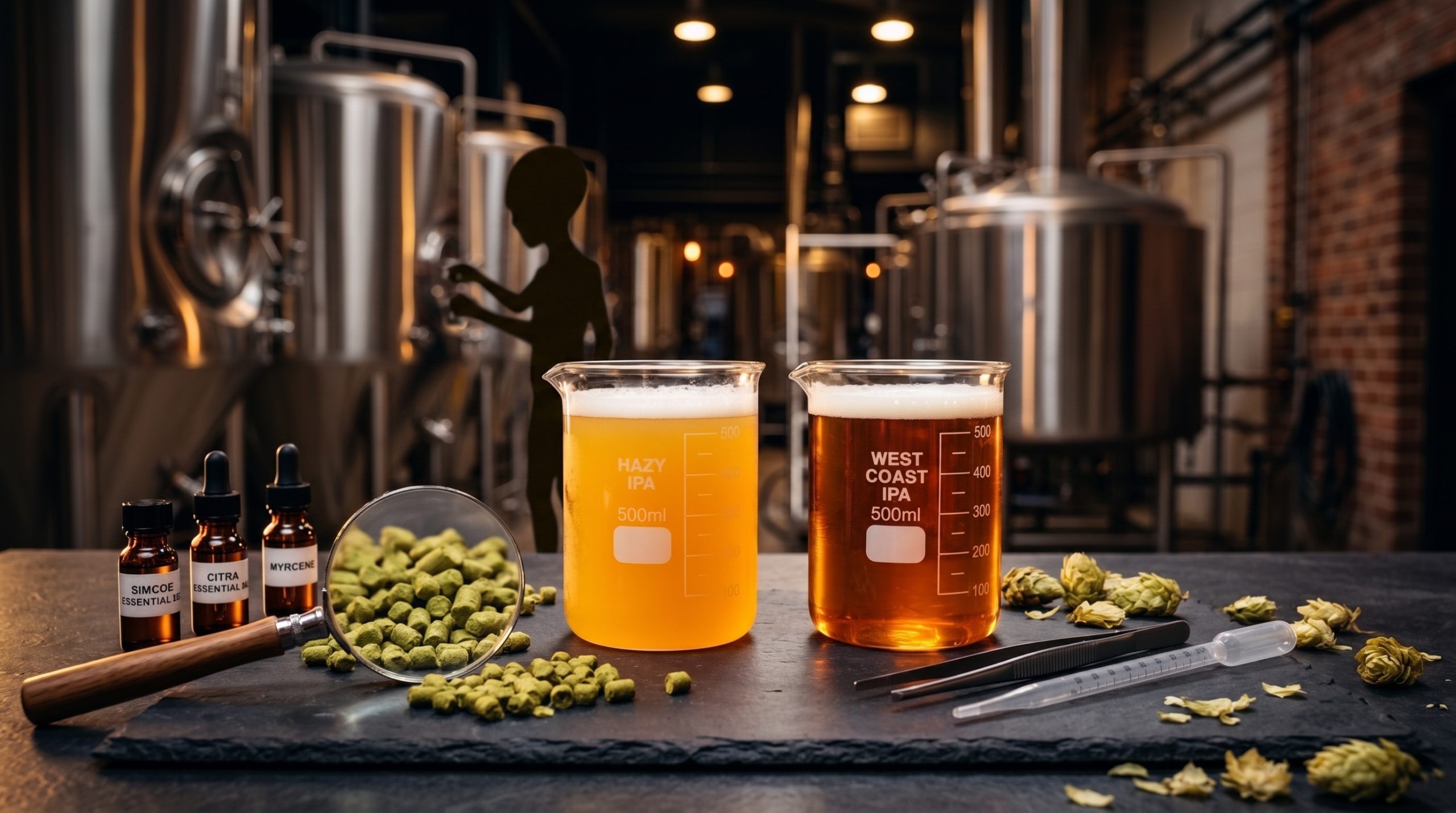
The short answer is yes—unquestionably. Hazy IPAs (NEIPAs) spoil, oxidize, and lose their desirable flavor profiles significantly faster than traditional, filtered clear IPAs like West Coast IPAs or English Pale Ales. While a clear West Coast IPA can maintain its intended flavor profile for 90 to 120 days under proper refrigeration, a Hazy IPA often begins noticeable chemical degradation in as little as 30 to 45 days. Lets break it down…
The Anatomy of a Spoiled Hazy IPA
You pull a three-month-old four-pack of a New England IPA from the back of your refrigerator. You pop the top, pour it into a clean glass, and instead of a vibrant, golden-orange tropical nectar, you are greeted by a dull, brownish-gray liquid with dark sediment clinging to the bottom. The rich, punchy aromas of mango and passionfruit have vanished, replaced by the unmistakable scent of stale cardboard, wet paper, and garlic.
Hop Forensics: Fast Facts
- Primary Spoilage Factor: Rapid oxidation of delicate dry-hop oils (Citra, Mosaic, Galaxy).
- Visual Shift: Suspended hop polyphenols react with oxygen, turning bright beer into a muddy brown.
- Peak Drinking Window: Consume Hazy IPAs within 14 to 45 days of canning.
- Temperature Control: Warm storage speeds up hop oxidation by up to 4x compared to cold refrigeration.
The Science: Why Hazy IPAs Degrade Rapidly
To understand why Hazy IPAs spoil so quickly, you must examine how they are made. Traditional clear IPAs utilize fining agents (like Irish Moss, Biofine, or gelatin) and mechanical filtration to remove suspended solids. Hazy IPAs, by contrast, intentionally preserve a complex matrix of suspended proteins, hop polyphenols, and yeast cells to create their signature silky mouthfeel and glowing appearance. However, that very matrix makes the beer hyper-vulnerable to decay.
1. High Concentration of Hyper-Sensitive Essential Oils
Hazy IPAs are defined by heavy late-stage and dry-hopping regimens—often utilizing 4 to 8 pounds of hops per barrel. Brewers rely heavily on tropical, aroma-rich hop varieties like Citra, Mosaic, Galaxy, and Nelson Sauvin. These hops are loaded with volatile essential oils, particularly myrcene, linalool, and geraniol.
These hydrocarbon compounds are delicate and volatile. When introduced to even microscopic amounts of oxygen during canning or draft transfer, these essential oils undergo rapid oxidation. The aromatic terpenes break down into oxidized byproducts, stripping the beer of its vibrant tropical citrus notes and leaving behind muted, stale aromas. For a deeper look into hop oil extraction, check out our guide on understanding hop chemistry and aromatic profiles.
2. Suspended Hop Polyphenols & Rapid Color Browning
The signature “haze” in a NEIPA is primarily a protein-polyphenol complex. Polyphenols are organic compounds extracted from hop vegetation during dry hopping. In an unfiltered, hazy environment, these polyphenols stay permanently suspended, bound to wheat and oat proteins from the malt bill.
When exposed to Dissolved Oxygen (DO) inside a package, these suspended polyphenols oxidize and polymerize. This chemical reaction causes a dramatic visual shift: the beer turns from a bright, glowing yellow-orange to an unappealing, muddy purple-brown. Because clear IPAs filter out most hop polyphenols, they rarely experience this drastic color shift.
3. Yeast Sedimentation and Autolysis (“Floaties”)
Many hazy IPAs are canned completely unfiltered, leaving living or dormant brewer’s yeast suspended in the liquid. Over time, gravity wins. The yeast cells clump together (flocculate) and settle out, creating dense white or dark flakes at the bottom of the can—commonly called “floaties.”
As those trapped yeast cells starve and sit in the alcohol solution, their cell walls rupture in a process called autolysis. Yeast autolysis releases lipids, amino acids, and enzymes directly into the beer, imparting off-flavors reminiscent of:
- Burned rubber or sulfur
- Miso or soy sauce
- Salty, savory broth
Hazy IPA vs. Clear IPA: Comparison Breakdown
| Feature | Hazy IPA (NEIPA) | Clear IPA (West Coast / Traditional) |
|---|---|---|
| Filtering / Clarification | Unfiltered; high protein and polyphenol content | Filtered or fined with clarifying agents |
| Peak Drinking Window | 14 to 45 Days from canning | 30 to 90 Days from canning |
| Oxidation Vulnerability | Extremely High (Sensory loss within weeks) | Moderate (Protected by higher bitterness/clarity) |
| Visual Aging Indicators | Turns brown/gray; forms large floating clumps | Slight loss of brightness; minimal color change |
| Flavor Aging Indicators | Cardboard, wet paper, sweet honey-like malt, onion/garlic | Muted pine/citrus aromatics, harsh resinous bitterness |
The Thermal Factor: How Temperature Accelerates Decay
Storage temperature is the single greatest variable influencing how quickly a hazy IPA degrades. Chemical reactions follow Arrhenius’ equation, meaning the rate of chemical reaction increases exponentially as temperature rises.
For every 10°C (18°F) increase in storage temperature, the rate of beer oxidation roughly doubles to triples.
- Cold Storage (35°F – 38°F / 1.6°C – 3.3°C): Suspends chemical reactions. Dissolved oxygen interacts slowly with hop oils, allowing hazy IPAs to remain stable for up to 60 days.
- Ambient Room Temperature (68°F – 72°F / 20°C – 22°C): Speeds up oxidation rapidly. Tropical aromas vanish in 14 to 21 days, and polyphenol browning accelerates dramatically.
- Warm / Trunk Storage (85°F+ / 29°C+): Destroys hazy IPA flavor profiles in as little as 48 to 72 hours. Yeast autolysis spikes, pressure increases inside the can, and extreme off-flavors develop.
How to Test Your Hazy IPA for Freshness
(Home Forensic Checklist)
If you suspect a hazy IPA in your fridge has passed its prime, perform this step-by-step evaluation before drinking:
- Check the Bottom Stamp: Locate the “Canned On” date. If the date is past 60 days, approach with caution. If there is no date stamped on the can, assume poor quality control from the brewery.
- Inspect the Pour in Natural Light: Pour the beer into a clear glass. A fresh hazy IPA should look like vibrant, opaque pineapple or orange juice. If it resembles muddy tea, dirty bronze, or gray gravy, heavy oxidation has occurred.
- Aroma Check (The Swirl Test): Gently swirl the glass and take a short sniff. Fresh hazy IPAs burst with guava, mango, passionfruit, and citrus. Stale hazy IPAs smell like wet cardboard, stale honey, crushed pills, or damp carpet.
- Check the Glass Bottom: Look at the bottom of your pour. Fine particulate haze is normal; large, heavy curd-like flakes indicate dead yeast settling out due to poor cold chain management.
Best Practices: How to Keep Your IPAs Fresh
If you want to enjoy hazy IPAs the way the head brewer intended, follow these strict handling protocols:
- Buy Direct from the Brewery: Purchase directly from local brewery taprooms where cans are stored in cold walk-in coolers immediately after canning.
- Avoid Warm Retail Displays: Never buy hazy IPAs displayed on warm supermarket shelves or exposed to bright fluorescent lighting.
- Maintain the Cold Chain: Transport your beer home in an insulated cooler or air-conditioned vehicle, and place it straight into your refrigerator.
- Drink Immediately: Treat hazy IPAs like fresh produce or dairy products. They are meant to be consumed fresh, never cellared or hoarded for special occasions.
For more technical breakdowns on shelf life and draft line management, visit the Home Brewers Association Quality Resources to learn how modern craft breweries manage packaged oxygen levels.

 Raymond