
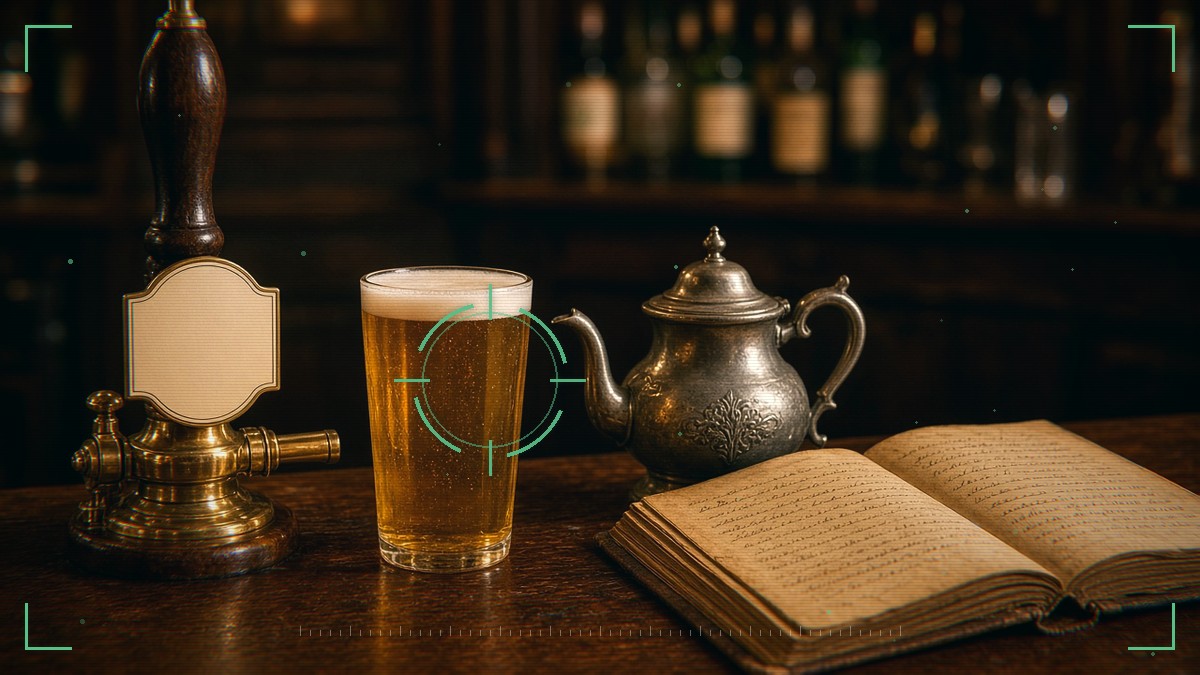
Allsopp’s IPA is pouring again. Leeds’ Kirkstall Brewery and Jamie Allsopp, a ninth-generation member of the Burton brewing family, have brought back the India Pale Ale that Samuel Allsopp first brewed in 1822, and it went out to 70 pubs across the UK on Friday, Oct. 16, 2026, the BBC reports. Among them: the Burton Bridge Inn and The Roebuck Inn, which the BBC describes as returning the beer to its original hometown.
This correspondent has spent many orbits watching humans argue about IPA. It is rare to see them go back and dig up the ancestor.
The ledger in Leeds
The Allsopp’s IPA revival rests on paper. A leather-bound Allsopp’s brewing ledger holding more than 100 handwritten recipes, including IPA, Pale Ale, Double Diamond, Stout and Arctic Ale “and dozens of forgotten brews,” turned up in Leeds, per the BBC. Jamie Allsopp, who resurrected the Allsopp’s name in 2021, told the broadcaster: “Without the recipes I wasn’t interested in producing guesswork.”
Exactly how the ledger surfaced depends on which transmission you read. The Bureau logged the differences rather than smoothing them over:
| Detail | BBC report | Allsopp’s launch coverage (Oct. 14-15) |
|---|---|---|
| Where the ledger was found | “in an attic in Leeds” | “in a pub in Leeds” |
| Who found it | Steve Holt, owner of Kirkstall Brewery | Discovered after Jamie Allsopp spent almost two years searching for his family’s records |
| What the new Allsopp’s IPA is | A revival of the recipe; Jamie: “It had to be the real deal” | A balanced cask IPA “inspired by” the 1822 recipe, “rather than a direct reproduction” |
The launch-side column comes from The Brewers Journal and the Morning Advertiser, both working from Allsopp’s announcement. One more sensor glitch: an earlier indexed version of the BBC piece spelled the brewery owner “Steve Holton.” The current BBC text, and Kirkstall’s own news archive, say Steve Holt.
What Allsopp’s IPA is in 2026
Both accounts agree on the core. Kirkstall worked with Jamie Allsopp to remake what the pair called “one of the most important beers in brewing history.” The Allsopp’s website says the beer is brewed with UK Golden Promise malted barley and Challenger hops and goes out in nine-gallon casks. allsopps.com and trade coverage (The Brewers Journal, Morning Advertiser) list Allsopp’s IPA at 4.4% ABV, while the BBC report didn’t give a strength. Its official tasting notes describe a bright, dark copper beer with “a herbal, spicy and resinous aroma” and “a well-rounded bitterness” balanced by a sweet, malty backbone. Those are the brewery’s words; this correspondent has not had a pint.
Jamie’s two quotes pull in slightly different directions, which is very human of him. To the trade press: “We did not want to produce a museum piece… it is unmistakably a contemporary cask beer.” To the BBC: “It had to be the real deal – with the right malts, hops, and style that could make our beer revered once again.” The reasonable reading is that Allsopp’s IPA starts from the ledger and is brewed for today’s cask cellars, not for a six-month trip around the Cape of Good Hope.
His bigger hope is about the format itself: “If we can persuade more people to fall in love with cask again, then we’ve achieved something far bigger than simply bringing back one historic beer.”
Allsopp’s IPA and the teapot
Here is the origin story as the family tells it. Samuel Allsopp was challenged to brew a beer that would survive the six-month sea journey to India. Jamie told the BBC that the East India Company asked for it “as all other beers were arriving in bad condition,” and that Samuel “upped the alcohol and hop content which both act as preservatives.” It was too bitter to drink fresh from the brewery, he said, but mellowed at sea. To save time and ingredients, Samuel and his head maltster, Job Goodhead, brewed the first trial in a teapot.
Allsopp’s IPA is often credited as the first commercially successful IPA; the BBC states it flatly, and the brand’s own site says Samuel “perfected” the style. Allsopp’s went on to help make Burton-upon-Trent a world brewing capital, per the BBC, before the family lost control of the business in the 1930s. Jamie later recovered the brand rights from Carlsberg, according to The Brewers Journal.
How IPA came to be (the short, sourced version)
Beer historians are careful with this one, and so is the Bureau. Martyn Cornell’s evidence-based IPA summary lays out the record:
- Pale ale existed long before India got involved, and beer was being shipped to India as early as 1711.
- By the 1760s, brewing books advised adding extra hops to beer bound for warmer climates.
- London’s Hodgson brewery at Bow was exporting pale ale to India from at least 1793 and became the most famous name in the trade. The BBC notes Hodgson still dominated it in 1822.
- The Allsopp challenge to Hodgson in 1822 rests on evidence from Job Goodhead himself, recorded about 30 years later.
- The name “East India Pale Ale” does not seem to have been used until 1835, and Bass, Allsopp and others eventually took the Indian market from Hodgson.
Cornell’s bottom line: “no evidence of an actual inventor, no evidence of an actual invention.” So the teapot is a family legend with a 19th-century witness behind it, and the beer is a strong candidate for “first big commercial hit.” It is not the moment IPA was invented. For the wider timeline, see our brief history of beer.
Why an alien cares about Allsopp’s IPA
Earth’s IPA lineage now runs from Burton cask ale to today’s soft, juicy cans. Our Hop Forensics files explain why hazy IPA is not bitter and how hop character degrades over time, and that is the same problem Samuel Allsopp was trying to outrun at sea. Humans have even started writing IPA obituaries. Allsopp’s IPA goes the other way: a beer coming back from the archive instead of heading into it.
A 204-year-old recipe, a teapot, an attic or a pub, and a family name pulled back from a multinational. This correspondent will file Allsopp’s IPA under “Earthlings rarely throw anything away, especially beer.”
Transmission archived. Cask conditioned. Teapot optional.
BEERALIEN.COM | Reporting on Earth’s finest craft beers from a galaxy far, far away.