
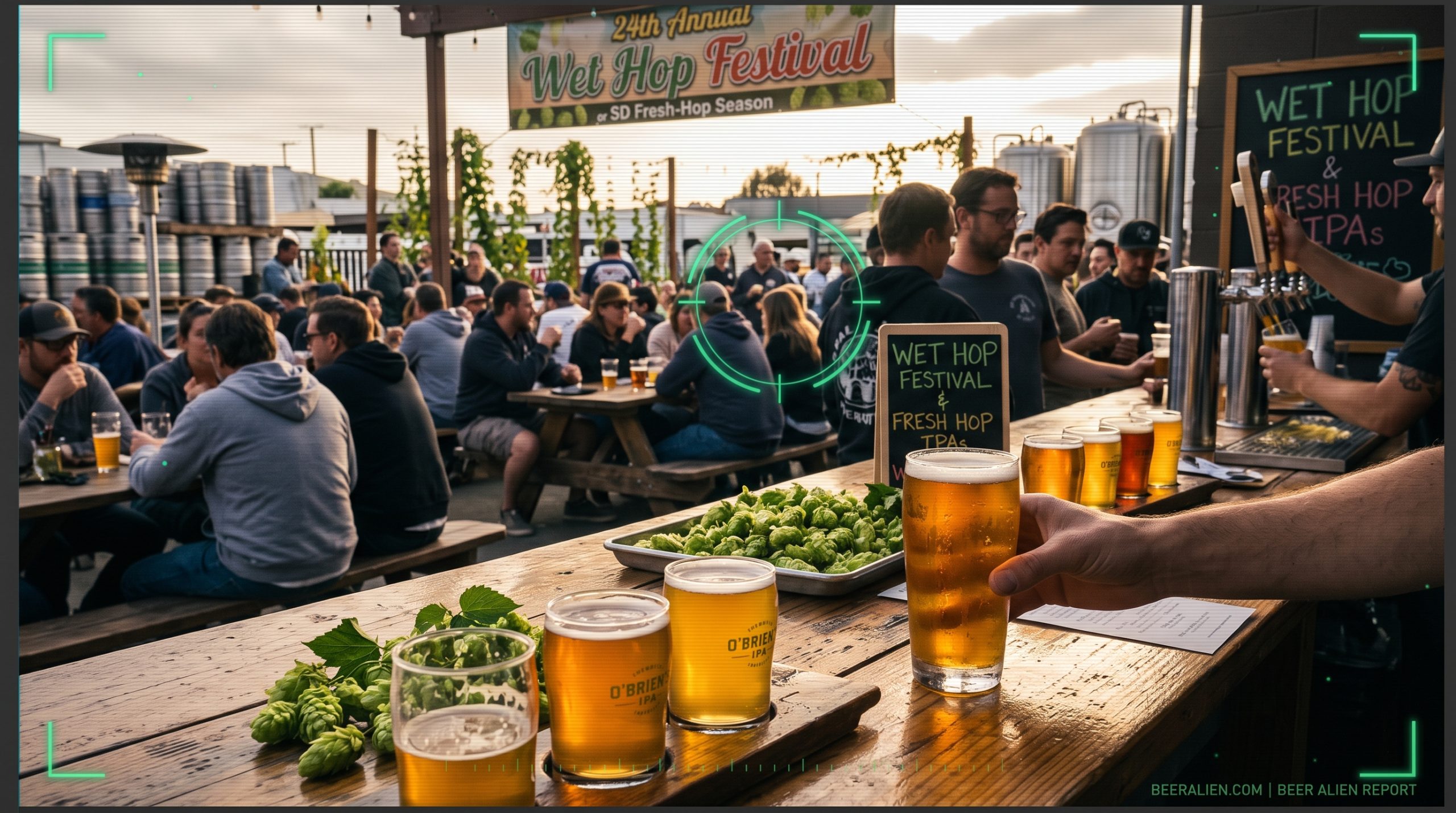
San Diego’s hop harvest window is short, and the Bureau’s scanners have been tracking the same signal for years: late August through early October is when whole-cone hops move from bines to brew kettles before the aromatic oils fade. Locals call the resulting beers wet-hop or fresh-hop, often using the terms interchangeably. The distinction matters less on a tap list than the timeline from field to fermenter.
Reference Log
Wet Hop vs. Fresh Hop: What the Terms Actually Mean
Most San Diego breweries treat “wet hop” and “fresh hop” as the same thing: hops picked and used while still green, typically within 24–48 hours. The Brewers Association style guidelines allow either undried (wet) or recently kilned hops added no more than 72 hours after harvest.
A clearer technical split comes from Sierra Nevada’s harvest guide. Wet hops are harvested and rushed into the kettle undried—Northern Hemisphere Harvest Wet Hop IPA uses a roughly 24-hour window. Fresh hops are kiln-dried and baled but still used within weeks, as in Celebration Fresh Hop IPA. Wet hops retain about 80% moisture, so brewers need roughly four times the weight of dried hops to hit the same intensity. The payoff is brighter, greener, more resinous character that dried pellets lose.
Tom Nickel of Nickel Beer Co. has put it simply for years: these beers are a snapshot of one field on one day, closer to a wine vintage than the consistency most breweries chase year-round. He told San Diego Beer News the flavors stay familiar—citrus, tropical, floral, earthy, spicy—but arrive differently.
San Diego’s Wet-Hop Champions and the Annual Festival
No one in the county has pushed the style harder or longer than Nickel. He routinely brews multiple wet-hop beers each season (11 in 2024) and hosts the long-running Wet Hop Festival at O’Brien’s Pub in Kearny Mesa. The 24th annual ran the weekend of Oct. 9–11, 2026, with 22-plus fresh-hop selections alongside the pub’s regular taps.
Nickel’s 2026 lineup, reported via the brewery’s newsletter and tracked by JollyPint and San Diego Beer News, included three wet-hop beers brewed with hops picked less than a day earlier:
- Green Truck Wet Hop Double IPA (8%, Oregon-grown Amarillo)
- High Country Wet Hop IPA (6.8%, Centennial, Columbus, Cascade and Chinook from High Country Hop Farms in Ramona)
- Golden Nugget Wet Hop Lager (5.5%)
High Country and Golden Nugget used local San Diego County hops. Pairing a wet-hop version of a year-round house recipe (High Country is built on Volcan) gives drinkers a direct comparison. The Bureau logged those three in the Oct. 9 new-releases roundup.
Other recent local entries include North Park Beer Co.’s Dripping with Dankness (DDH wet-hopped IPA with more than 300 pounds of wet Strata) and TapRoom Beer Co.’s DAMP wet-hop West Coast IPA. TapRoom’s head brewer Daniel Cady has released multiple fresh-hop beers in recent seasons, often experimenting beyond IPAs into pilsners and other styles, as detailed in San Diego Beer News coverage. Coronado Brewing has packaged larger canned fresh-hop releases in past years using Yakima Valley hops rushed in via partners like Yakima Chief Hops and Ripe Locker.
Local Hops and the Practical Limits
San Diego County is not the Pacific Northwest. Small hop farms in places like Ramona, Fallbrook and Julian have supplied same-day cones for years, but the commercial industry remains limited. Many earlier operations scaled back or closed, as noted in past San Diego Union-Tribune reporting; the remaining yards are modest and labor-intensive. When local cones are available, brewers value the short truck ride and the chance to feature county-grown hops in limited releases. Most volume still comes from Yakima Valley or Oregon farms, often coordinated for next-day delivery.
Why the Season Is Worth Tracking
These beers do not keep. The bright, grassy, resinous notes that make them special diminish quickly, which is why festivals, taprooms and limited cans cluster in September and early October. O’Brien’s Wet Hop Festival remains the clearest single place to taste a wide range in one weekend. Individual brewery taprooms (Nickel in Julian, North Park, TapRoom and others) pour their own versions as they finish.
Fresh-hop season is still active as of mid-October 2026; the window closes as the last harvests finish and the cones are either dried or used. For more on current San Diego tap lists and releases, see the Bureau’s ongoing coverage of new local beers.
External references for the definitions and history include Sierra Nevada’s harvest guide and San Diego Beer News coverage of Nickel and the festival. Local tracking lives on sites such as JollyPint and the weekly What’s Tapping lists.
BEERALIEN.COM | Reporting on Earth’s finest craft beers from a galaxy far, far away.