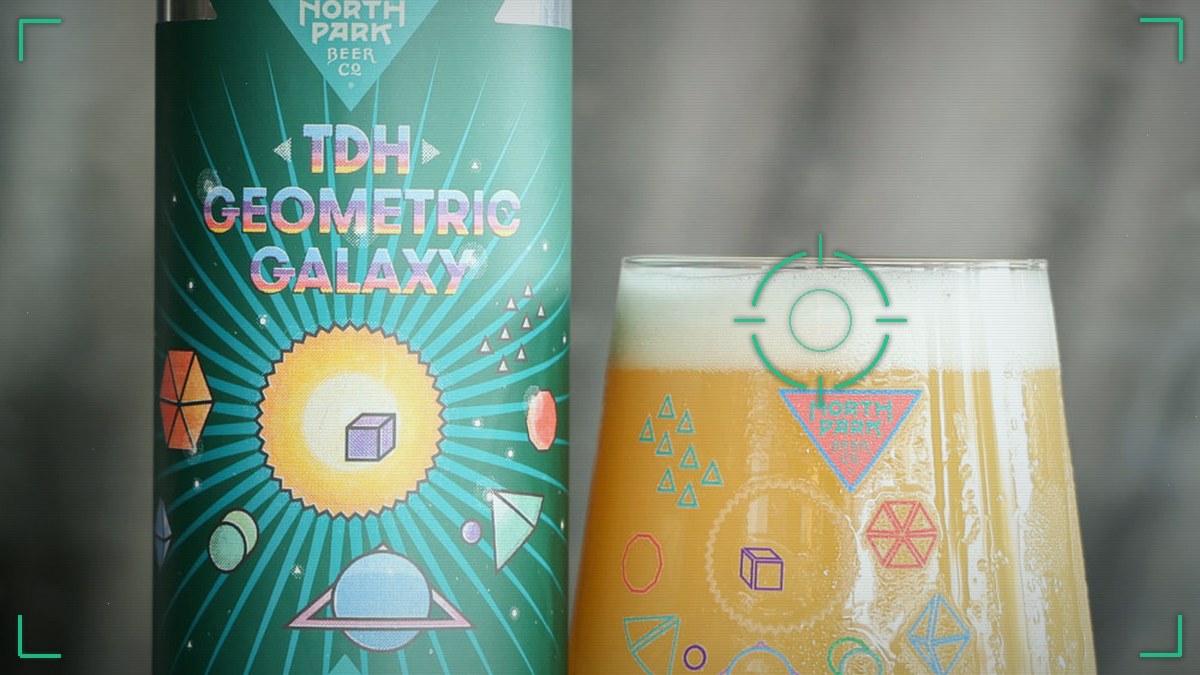
Walk the can aisle this week and you will see DDH and TDH almost as often as IPA. Double dry-hopped and triple dry-hopped have become a kind of shorthand for “this one got a lot of hops after the boil.” The labels are not regulated, and a double dry-hopped can does not promise a standard rate. Those letters tell you, at most, that the brewery added hops more than once on the cold side. North Park Beer Co.’s new cans are a clear local example: Dark Side of the Fu! is a double dry-hopped India Black Ale, while Geometric Galaxy and Aroma Constrictor are marked TDH.
Dry hopping itself is older than the acronyms. It means adding hops to beer after the kettle, usually in the fermenter or a serving tank, so the oils that would have boiled off can stay in the glass as aroma. A single dry-hop charge is still a dry-hopped beer, just not a double dry-hopped one. Double dry-hopped usually means two charges, often one during active fermentation and one after, or two additions a few days apart. Triple dry-hopped, or TDH, adds a third charge on top of a double dry-hopped schedule. Some breweries treat the terms as marketing for a heavier hop load rather than a literal count of additions. There is no industry rulebook that settles the difference.
How much hop goes into a double dry-hopped beer
For a double dry-hopped beer, the useful question is not only the number of times the hops went in. It is how much went in, and whether the beer can hold any more aroma. In 2018, Scott Lafontaine and Thomas Shellhammer at Oregon State published a study in the Journal of the Institute of Brewing on static dry-hopping with Cascade. Hop aroma intensity kept rising from 200 to 1,600 grams per hectoliter, but the gains flattened above 800 g/hL, about 2 pounds per barrel. At 1,600 g/hL, herbal and tea notes jumped while citrus did not meaningfully increase. The authors pointed to 400 to 800 g/hL as the efficient range for a balanced hop aroma. A later review of dry-hopping research, in Molecules in 2023, reached the same broad conclusion: more hops help up to a point, then the beer saturates, and very high rates can tilt the flavor toward vegetal or herbal notes, chew up yield, and even set off “hop creep,” a leftover fermentation caused by enzymes in the hops.
That is why a triple dry-hopped can is not automatically louder than a double dry-hopped one. If the first two charges already pushed the beer toward that 800 g/hL plateau, a third charge may change the timing or the hop mix more than the intensity. It can still be worth doing. Split additions can catch different stages of fermentation, and a later charge can refresh volatile aromas that fade. It is just not a guarantee that a triple will out-aroma a double dry-hopped beer. Geometric Galaxy is an honest version of the claim: North Park says it took a double dry-hopped beer and “amped up the flavor with an additional dose” of Citra, Mosaic, Galaxy and Nelson Sauvin. The TDH mark, in that case, is a third charge on top of a known beer, not a mysterious new process.
Cryo, DynaBoost and the products behind the acronyms
The other half of the label is often the hop product, not the number of additions. Yakima Chief Hops makes two of the names on North Park’s cans this week. Cryo Hops are lupulin-enriched pellets, with the leafy material largely removed, so a brewery can add concentrated oils and resins with less vegetal bite and less beer lost in the trub. Dark Side of the Fu! uses Columbus Cryo, Simcoe Cryo and Mosaic Cryo in a double dry-hopped black ale. We have written before about how these concentrated formats sit next to whole cones and T-90 pellets in our hop extracts guide.
DynaBoost is a different tool. Yakima Chief launched it in 2024, after calling the same product YCH 702, as a flowable, variety-specific hop extract made for the whirlpool, not the dry-hop tank. The company says 1 kilogram replaces about 10 kilograms of T-90 pellets and that the extract can raise hot-side yield by up to 5 percent. It is currently sold in Citra, Mosaic, Simcoe, Sabro and Centennial. When North Park lists Citra DynaBoost in a triple dry-hopped Aroma Constrictor, that extract almost certainly did its work in the whirlpool, with Cryo and regular pellets handling the cold-side charges. “TDH” describes the dry-hop schedule. DynaBoost describes a hot-side product that can make the finished beer taste hoppier before those dry hops ever go in.
You will also see this language on West Coast beers, not only hazies. North Park’s Origins of Fu!, released earlier this month, is a triple dry-hopped West Coast double IPA. The acronym is not a style. It is a process claim, and it is only as meaningful as the recipe behind it.
BEERALIEN.COM | Reporting on Earth’s finest craft beers from a galaxy far, far away.