Doppelbock is the strong, malty lager that Munich’s monks drank through Lent, and San Diego has a fresh one on tap: East Village Brewing is pouring Pajama Pants, a 7% spiced doppelbock made with caramelized Asian pears, cardamom, cloves and vanilla. San Diego Beer News listed it among the beers tapping the week of Nov. 19. This guide explains what a doppelbock is, why so many of these beers end in “-ator,” how the style differs from bock and maibock, and where eisbock fits, using the Beer Judge Certification Program’s 2021 guidelines.
What is a doppelbock?
The Beer Judge Certification Program (BJCP) defines the style in category 9A as “a strong, rich, and very malty German lager” that can be pale or dark. The name means double bock. Most examples are dark, from copper to dark brown, but the BJCP notes that excellent pale versions exist. Dark ones show deeper toasted and caramelized malt, sometimes a slight chocolate note and dark fruit such as plums. Pale ones are deep gold to light amber, a little hoppier and drier.
The BJCP’s numbers for the style are 7% to 10% ABV, 16 to 26 IBUs, an original gravity of 1.072 to 1.112 and a final gravity of 1.016 to 1.024. Hop bitterness should let malt dominate, with virtually no hop aroma, a medium-full to full body and a smooth finish. Alcohol warmth “should never burn.” The malt bill is typically Pilsner, Vienna and Munich malts with traditional German hops and a clean lager yeast, and decoction mashing, in which part of the mash is boiled, is traditional.
Salvator and the “-ator” names
According to the BJCP, this is a Bavarian specialty that began in Munich, first made by the monks of St. Francis of Paula by the 1700s. Early versions were less fully fermented than modern ones, so they were sweeter and lower in alcohol. The monks called the beer “liquid bread” and drank it during the Lenten fast.
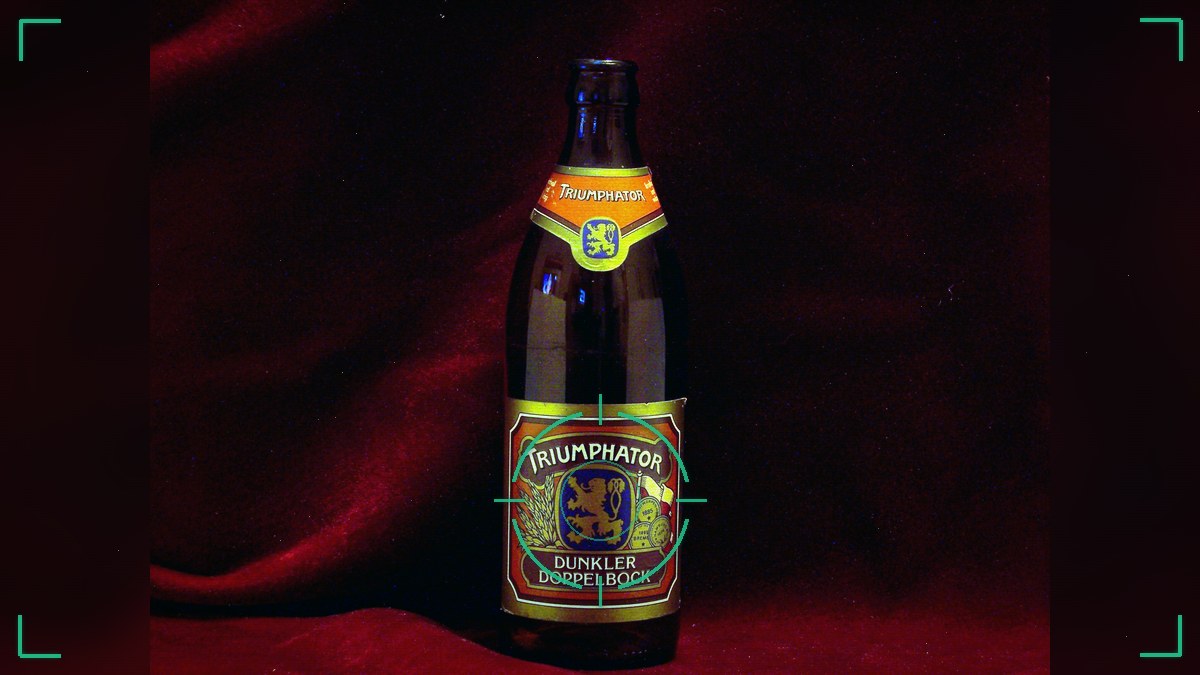
The best-known example is Paulaner Salvator, and it explains the naming habit. The BJCP says breweries adopted names ending in “-ator” after a 19th-century court ruling that no one but Paulaner was allowed to use the name Salvator. The bottle we looked at carries “Seit 1634” on its label. Other “-ator” beers in the family include Spaten Optimator, Tröegs Troegenator and Ayinger Celebrator, all listed by the BJCP as commercial examples. The Triumphator Dunkler Doppelbock in our photo follows the same pattern.
Doppelbock vs. bock, maibock and eisbock
This style sits at the top of a family of German lagers. The BJCP places the others in these categories:
- Helles bock, or maibock (4C): a pale, strong, malty lager at 6.3% to 7.4% ABV, with more apparent hops and less deep malt than other bocks. The BJCP ties maibock to spring and the month of May, and lists Chuckanut Maibock among its examples. It says a helles bock is less strong than a pale doppelbock but has similar flavors.
- Dunkles bock (6C): a dark, toasty lager at 6.3% to 7.2% ABV that is not sweet in the finish. “Bock” means “ram” in German, which is why a ram turns up on so many labels, and the style began in Einbeck. The BJCP says it has less alcohol and malty richness than a doppelbock.
- Doppelbock (9A): stronger, richer and fuller-bodied than either, according to the BJCP.
- Eisbock (9B): a beer in the same mold that has been frozen, with the ice removed.
What is an eisbock?
Eisbock, pronounced “ICE-bock,” is made by freezing a strong bock and removing some of the ice, a process the BJCP calls “freeze distillation.” That concentrates flavor and alcohol, and any flaws too. The style is from Kulmbach in Franconia, dates to the late 1800s, and its exact origin is unknown. Fables say it began when a beer froze by accident at a brewery. The BJCP lists Kulmbacher Eisbock as its example.
The BJCP’s numbers for eisbock are 9% to 14% ABV, 25 to 35 IBUs, a very full body and low carbonation. It warns, in its eisbock guideline, that eisbocks are not simply stronger doppelbocks: the name refers to the freezing process, not strength, and some doppelbocks are stronger than some eisbocks. Extended lagering after the freeze helps smooth the alcohol.
Pajama Pants, a San Diego doppelbock
East Village Brewing’s own Batch 189 page lists Pajama Pants as a spiced doppelbock at 7.0% ABV, 25 IBUs and 30 SRM. The malts are Weyermann Pilsner, Munich 1, Melanoidin, CaraBohemian and Carafa 2, with Spalt kettle hops and White Labs’ Old Bavarian yeast. It was made with Specialty Produce Grocery, which caramelized Asian pears and toasted cardamom pods and cloves that went in at the end of fermentation, with a touch of vanilla. The brewery’s notes give chocolate and caramel as the main flavors, and its sensory line reads caramel, toasted pecan and pie crust, with a medium, balanced body.
At 7.0%, it sits at the bottom of the BJCP’s range, where the BJCP says most traditional examples fall. The BJCP description lists no spices, so the pear and cardamom are East Village’s twist rather than part of the style. The brewery’s older recipe page lists an earlier batch, Batch 143, at 7.5%, so check the current strength before you order. East Village Brewing is at 201 Park Blvd., Suite 101, and it is on our San Diego brewery list.
How to find and drink a doppelbock
Look for the style name on the label, or a beer name ending in “-ator.” Because it is a lager, the malt should come through clean and bready, without fruity yeast flavors, and the BJCP wants the alcohol warming but never hot. Take your time with it. For more malty lagers, see our guide to Czech dark lager and our post on Dovetail’s double-decocted Winter Hopfenlager. For a pale cousin, look at maibock, such as Chuckanut’s.
Doppelbock and eisbock FAQ
BEERALIEN.COM | Reporting on Earth’s finest craft beers from a galaxy far, far away.